

TREASURES OF WAR
WWII US 8th Air Force POW Grouping to TSgt Michael J. Trainor B-17F Flying Fortress, Shot Down by a Messerschmitt Me 109,
Stalag Luft III (“The Great Escape”) & Stalag XVII-B


This is a fine grouping of Technical Sergeant Michael Joseph Trainor, Massachusetts, USA, served as a Radio Operator/Air Gunner, 381st Bomb Group, 534th Bomb Squadron, Eighth Air Force. B-17F Flying Fortress 42-3118 “Green Hornet” Stationed at RAF Ridgewell, Essex, England.


On 11 January 1944, while flying aboard B-17F Flying Fortress 42-3118, “Green Hornet,” as part of Group Mission No. 59 to bomb aircraft factories at Oschersleben, Germany.
The 1st Bombardment Wing, including the 381st Bomb Group, failed to receive the recall signal while over occupied Europe. As a result, approximately 180 of the 700 bombers involved in the mission continued towards their target without fighter escort protection.
During the operation, Michael Trainor’s B-17 Flying Fortress came under attack from a German Messerschmitt Me 109 fighter. The aircraft sustained severe damage, with two engines knocked out and further damage caused by anti-aircraft flak. Unable to maintain control, the bomber crashed near Goslar, close to Bernburg, approximately 20 miles south-west of Oschersleben, Germany. The loss was officially recorded in Missing Air Crew Report (MACR) 1875.
Following the aircraft’s destruction, the crew were initially reported as Missing in Action on 11 January 1944. The crew comprised: Pilot Austin Larson; Co-Pilot Francis Wilson; Navigator Horace Neff; Bombardier George Regan was wounded and taken to military hospital; Flight Engineer and Top Turret Gunner Edwin Nix; Radio Operator Michael “Mike” Trainor; Ball Turret Gunner Milt Copeland; Waist Gunner John Crawbuck; Tail Gunner Alex Williams, all of whom became Prisoners of War. Waist Gunner Ross Defenbaugh was killed in action.
Trainor survived the crash and was captured by German forces. After a brief period in a transit camp, he was transferred to the notorious Stalag Luft III, the Luftwaffe prisoner-of-war camp that would later become famous for the events known as “The Great Escape.”
The escape plan was conceived by RAF Squadron Leader Roger Bushell and authorised by the camp’s Senior British Officer, Group Captain Herbert Massey. Three tunnels were constructed and codenamed Tom, Dick, and Harry. In March 1944, seventy-six Allied prisoners escaped through Tunnel Harry. Although three men successfully reached freedom, the remaining escapees were recaptured by the Gestapo, and fifty were illegally executed on the direct orders of Adolf Hitler.
Trainor was definitely present at Stalag Luft III in mid-February 1944, as confirmed by a prisoner-of-war postcard he sent to his mother on 19 February 1944. Further research is required to determine precisely how long he remained in the camp. However, it is highly likely that he was present during the period when the escape tunnels were being completed and possibly during the March 1944 escape itself. With more than 600 prisoners involved in various aspects of the tunnelling and escape preparations, it is conceivable that he may have played some part in the operation.
Trainor was later transferred to Stalag XVII-B in Austria, located near the village of Gneixendorf. Originally used as a concentration camp from 1938 to 1940, the camp subsequently housed French and Polish prisoners of war before receiving increasing numbers of Allied airmen during the war.
On 13 October 1943, 1,350 non-commissioned officer prisoners of war were transferred from Stalag VII-A to Stalag XVII-B. By January 1944, the camp population had risen to 2,667 and continued to grow despite repeated complaints regarding overcrowding. By the final stages of the war, nearly 5,000 Allied NCOs were held there, while the total prisoner population of the camp reached almost 30,000 men of various nationalities.


This remarkable and well-documented prisoner-of-war grouping to Sergeant Michael Joseph Trainor consists of:
1. Named Purple Heart Medal, complete with original presentation box, spare ribbon bar, and pin-back fitting.
2. Named Air Medal, complete with original presentation box, spare ribbon bar, and clutch-back fitting.
3. Prisoner-of-War postcard sent to his wife, Rose, from a transit camp shortly after his capture. Censor-marked and dated 16 January 1944.
4. Prisoner-of-War postcard sent to his mother, Nora, from Stalag Luft III, dated 19 February 1944.
This camp would become world famous following the events of The Great Escape in March 1944.
5. POW Camp Identification Photograph, showing Trainor holding his prisoner identification board, stating camp XVII-B and no. 105961.
6. Photograph Album containing more than 79 photographs, primarily documenting his training period in the United States. Unfortunately, a section from the middle of the album has had photographs removed, which were likely taken during his service at RAF Ridgewell.
7. Copy of Missing Air Crew Report (MACR 1875) detailing the loss of B-17G 42-3118 “Green Hornet” on 11 January 1944.
8. Genuine WW2 8th Air Force USAAF, American shoulder sleeve insignia of the 8th Air Force 'Mighty Eight', this has been added to this group.
This grouping provides a fascinating insight into the wartime service of an American airman who survived the loss of his aircraft, imprisonment in two of Germany’s most notable prisoner-of-war camps, and who may well have witnessed, or even participated in, events surrounding one of the most famous escape attempts of the Second World War.


A great photo from the album of the Larson Crew, with a fresh face image of Michael highligted below.


Above 42-3118, GD-C B17F Bomber 'The Green Hornet'


Both Stalag Luft III and Stalag XVII-B inspired some of the most famous prisoner-of-war films ever made. Stalag Luft III became synonymous with the 1963 film “The Great Escape,” starring Richard Attenborough, James Garner, Charles Bronson, Donald Pleasence, James Coburn, and others.
A decade earlier, “Stalag 17” (1953), directed by Billy Wilder and starring William Holden, was based on the experiences of former prisoners Donald Bevan and Edmund Trzcinski at Stalag XVII-B. The film was later adapted into a successful Broadway play and served as inspiration for the popular 1960s television series “Hogan’s Heroes.”


Genuine WW2 U.S. MKIIA1 “Pineapple” fragmentation Grenade M10A2 Fuse


A genuine U.S. World War 2 MkIIA1 fragmentation grenade, Manufactured Late 1942, commonly referred to as the “pineapple” grenade, fully inert.
The cast-iron body remains solid and well-defined, with good definition to the segmented exterior. Surface wear is consistent with age and service handling, with no cracks or structural issue.
The segmented form gave the grenade its well-known “pineapple” nickname and also provided improved grip when handled in the field. There are two initials on one side of the body, “A F” this refers to “American Fireworks” one of several manufacturers (like Eastern U.S. Arsenal, National Fireworks, Hercules, etc.), Fitted with an M10A2 series fuse, clearly marked to the top. The fuse assembly appears complete and intact, with expected wear and patina consistent with age. The presence of this fuse type is correct for period examples. Overall condition is very good for a wartime example. The grenade shows honest service wear, surface patina, and age-related finish loss.
WW2 U.S Army T.N.T Block & Electrical Detonator & Wire


WW2 U.S Army T.N.T Block & Electrical Detonator
U.S half pound block of T.N.T for front line demolitions complete with electrical detonator on its length of original wire. Filled with an inert silicone to give a realistic full weight. Both items INERT & F.F.E
US WW2 Lucky Strike Cigarettes in early series 111, 1940-41


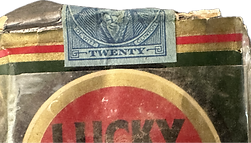


Original US WW2 Lucky Strike Cigarettes in early green package, series 111 which dates to 1940-41, have been opened although seal still intact and with original Cigarettes.
WWII US Army 8th Air Force Patch


A standard American made 8th USAAF patch. Full wing design, used and removed from uniform with light service wear.
Mighty Eighth tasked with the daylight bombing. In total, the 8th Air Force lost over 26,000 men. An additional 28,000 men became prisoners of war. Aircraft losses were also grim: 10, 561 planes of varying types were shot down, 4754 of those were B-17 heavy bombers.
Movie prop M1 Garand rifle from David Ayer's war Film “Fury”.


A Movie prop M1 Garand rifle from David Ayer's war film “Fury”. As the standard issue rifle of the U.S. Army in World War II, the M1 Garand is seen used and carried by numerous American GI's throughout the film.
Cast in high detail, even has the the maker Springfield Armory, the serial number which dates to May 1944, the prop rifle is made of dense urethane and features faux wood texturing over most of the piece. The gun is also detailed with a faux metal finish over the trigger and around the bolt,The sling hardware are metal, and I’m told the gun has a metal rod going through to keep it straight.
This item shows signs of wear with scuffing and scratches to the paint, but remains in otherwise good, production-used condition.
film prop used on the movie fury comes with certificate of authenticity and signed by the star of combat dealers Bruce Crompton.


Normandy Relics


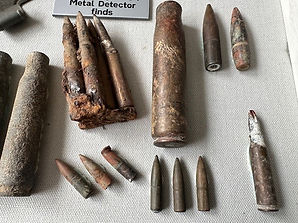


This is a Shadow box I've made myself from some of the finds while I was metal detecting in Normandy in 2004, these finds are from Utah Beach and Carentan area. I also collected the sand from each of the 5 Normandy beaches. An interesting array of US items, but note the unfired dummy round "bullet" in the right hand corner of the box, this is dated 1962, NOT WW2, but arguably the best WW2 war film was filmed on and around Utah Beach in 1962 which was "The Longest Day" this was found in dunes on Utah Beach, so there is more than a good chance this is a film prop dummy round from the film that was dropped and never fired.